Imaging
Cameras
The main imaging CCD cameras I use are the SBIG STL6303E , Finger Lakes Instruments IMGIMG6303E and IMG1001E systems with a 3K x 2K x 9 micron pixels and 1K x 1K x 24 micron pixels respectively. I started out with the IMG1001E camera in the late 1990's and since Sept. of 2001 most of my images were either taken taken with the IMG6303E or SBIG STL6303E cameras. The benefit of the smaller pixels and big array is that depending on object size, resolution required and speed of download times I have more flexibility in my imaging acquisition.
MAXIM DL/CCD is used to control the camera, take images and color combine the LRGB and LCMY images. PhotoShop 6.0 is used to further process the color images.
I was one of the original purchasers of the Finger Lakes CCD cameras in the late 1990's and modified the original camera to allow a larger clear aperture and reduce vignetting. FLI now manufacture cameras that have larger clear apertures to accommodate large CCD’s. In addition I changed the fill gas to Argon instead of Nitrogen to obtain a few more degrees of cooling especially in summer months. The KAF1001E and 6303E chips achieves optimum low noise operation at –35 degrees C and lower. –35 degrees C is easy to achieve during spring, fall and winter months however with summer nights at a 25 degrees Celsius ambient it is difficult to achieve the optimum CCD temperature for low noise operation.
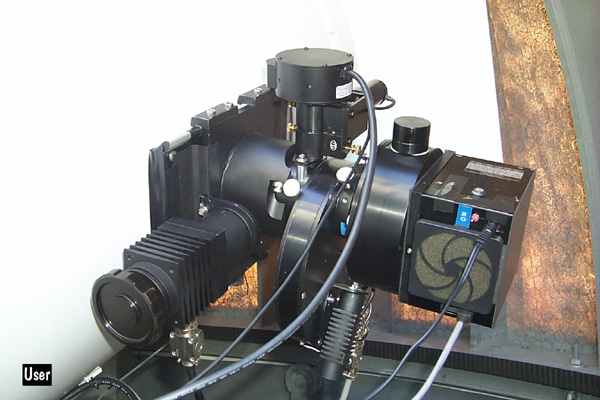
The picture above shows an older modified FLI CCD camera on my 20" Homebuilt Newt, with a home built 2 inch filter wheel and motorized Crayford focuser. In addition the photo shows a ( Oct. 2000) modification to the focuser tube for off-axis guiding using the venerable ST-237 as the autoguider. The off axis guider has remote motorized focusing to allow refocus when changing filters or using no filter for straight through broad spectrum exposures. The whole assembly is rock solid and once the temperature of the scope has stabilized focus does not need adjustment between exposure series. The off axis guider has been invaluable for obtaining narrowband color images because the guide camera is in front of the filter wheel. Once you have guide star lock you will keep it all night barring clouds or high wind.
A Coastal Optical field corrector was incorporated on the 20" Newt for removing coma and changed the F/4 design of my main scope to an f/5. I had the corrector designed this way to provide a 1.9 arc second pixel image scale with the IMG1001E CCD camera which matches the system performance to the average seeing conditions here in New England. The 1.9 arc seconds is somewhat of a compromise between max field size and resolution however the 6303E camera allows 1.5 arcsec/pixel image scale in 2x2 bin mode and 0.75 arc sec/pixel in 1x1 mode. My main imaging interest is reflection and emission nebula regions that are generally large area objects.
Most of my work today on the RCOS 20 or my homemade 12" f/4 Newt astrograph uses either the SBIG STL6303E or IMG6303E. Both cameras are robust and mature designs. The FLI is favored for higher ambient humidity operation or when brighter stars fill the field using it's non cover slip CCD option while the SBIG is a very nice compact design suited for smaller scopes as well as big scopes. Each has it's own merits which can influence the decision of which one to buy or use.
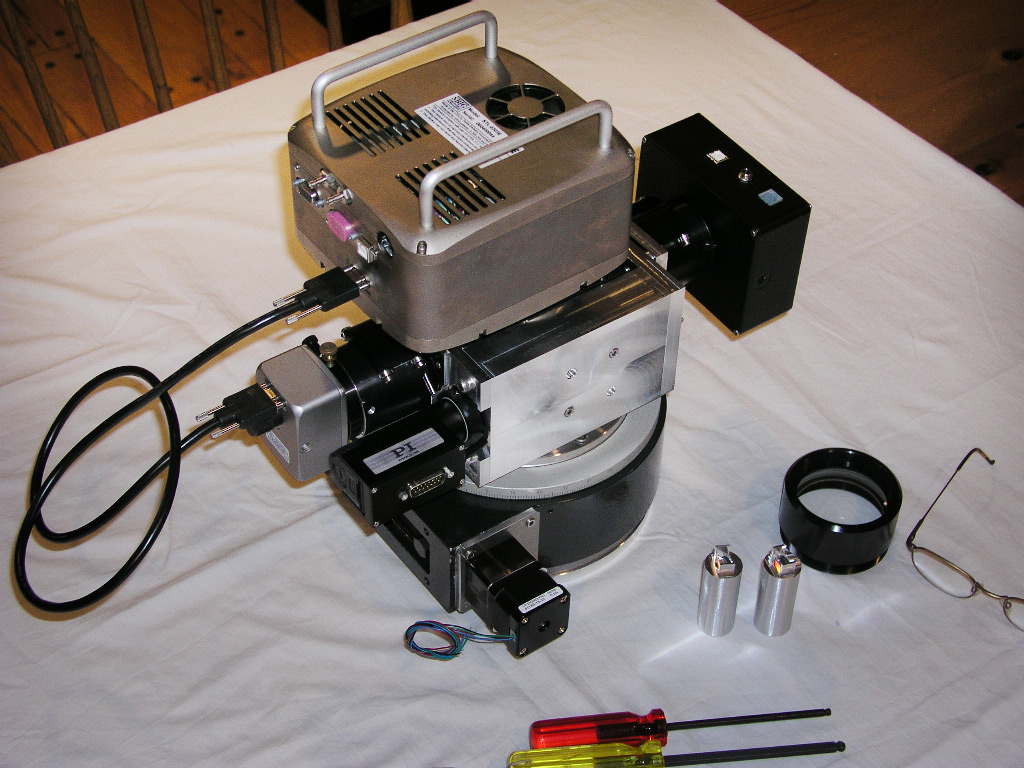
The photo below shows the new design and construction of a dual off axis autoguider port ( with motorized remote focus and field scan) with a precision instrument rotator that will be installed on my RCOS20 by summers end in 2005. In this photo you can see the pick off prism tubes and RC field flattener which will be installed inside when all the parts are anodized.